OPEN CALL 2026 MAKE DEATH SOFT AGAIN LAB
A collective artistic research laboratory exploring finitude, the ecologies of dying, and the transformation of matter.
Residency: 16–22 December 2026
Location: Mieres (Girona)
Application deadline: 10 November
How to apply: via this form
Selection announcement: 25 November
DU-DA opens the first call for applications for MAKE DEATH SOFT AGAIN LAB, an intensive laboratory for artistic research and creation that invites participants to explore the ecologies of dying, the material cultures of death, and imaginaries of transformation through artistic, experimental, and transdisciplinary practices.
We are interested in imagining other ways of accompanying death, but also other ways of accompanying life. In understanding bodies as ecosystems. In thinking of microorganisms as allies. In exploring disappearance as a form of continuity. In experimenting with other ways of relating to waste, organic matter, and processes of decomposition, beyond fear, concealment, or their technical management.
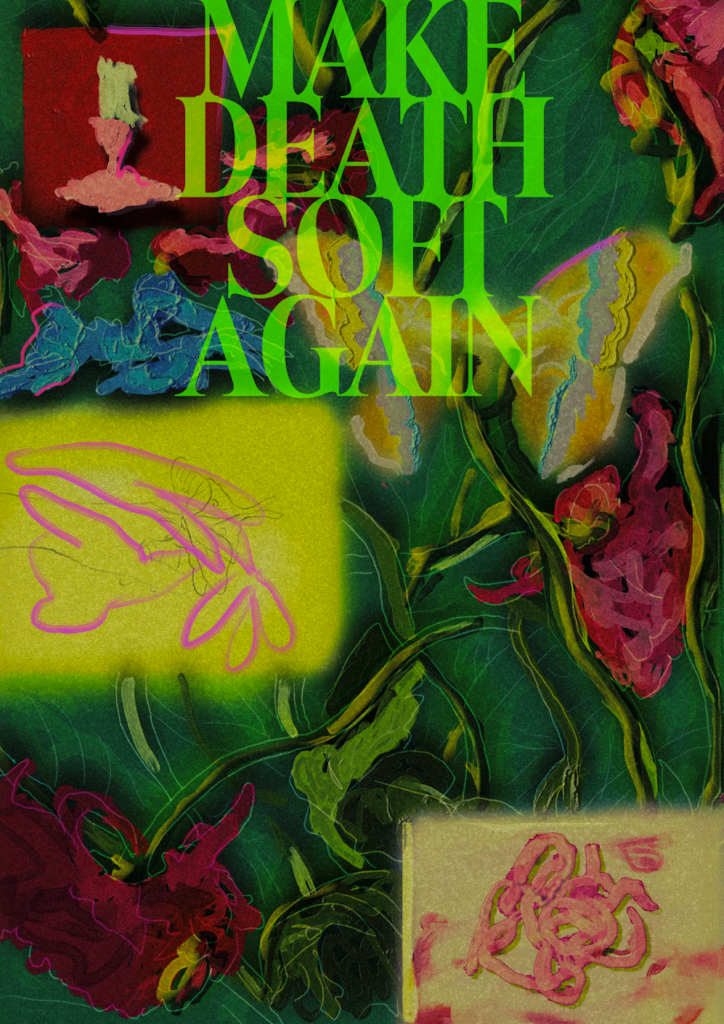
Illustration by Hannah Nishat Botero
MAKE DEATH SOFT AGAIN LAB builds on the research developed through Morir Guay, DU-DA’s project which, since 2019, has explored the cultural, political, ecological, and material dimensions of death.
In this LAB, DU-DA opens up its methodologies, references, and working tools to bring them into dialogue with other artistic practices. We want to create a temporary research community in which questions, knowledge, and methodologies can contaminate one another and give rise to new connections, narratives, speculations, prototypes, and ways of doing.
For one week, we will share time, work tables, readings, conversations, research processes, references, intuitions, and questions.
THE LAB AS A SPACE FOR KNOWLEDGE TRANSFER
During the residency, DU-DA will share materials and research developed throughout its projects, particularly Morir Guay and MAKE DEATH SOFT AGAIN. We will open up methodologies, references, readings, case studies, research tools, and prompts that can activate new questions and enter into dialogue with the participants’ practices.
DU-DA’s contributions will function as prompts for generating connections, new narratives, speculations, experiments, and possible prototypes, without any specific outcome being predetermined.
Each participant will have time to present their research, processes, methodologies, interests, or ongoing projects and bring them into dialogue with the rest of the group. We are particularly interested in what can happen when different research processes come into contact, what unexpected connections emerge, and what new questions might arise.
DU-DA brings its research, methodologies, and experience, but knowledge does not circulate in a single direction. The participating artists and researchers also open up their practices, and their questions can transform the research framework itself. For this reason, we understand the LAB as a circular pedagogy: a temporary infrastructure for transmission and research in which knowledge circulates, changes, and is collectively produced.
We are not seeking to arrive at a shared conclusion or produce a homogeneous outcome. We are interested in creating the conditions for differences, frictions, deviations, and new possibilities for thinking and practice to emerge.
WHAT WILL WE EXPLORE?
The LAB is open to proposals working, among other areas, around:
- poetics of finitude;
- processes of decomposition, transformation, and regeneration;
- microorganisms, fungi, and living processes;
- speculative design and prototyping;
- biomaterials and the material cultures of dying;
- plant fibres and agricultural waste;
- fermentation and other processes of material transformation;
- biodegradable textiles and natural dyes;
- rituals, memory, and forms of inheritance;
- body, territory, and interdependence;
- art, science, and experimental practices;
- imaginaries and technologies of life and death;
- ecofeminist, multispecies, and decolonial practices;
- forms of accompaniment, care, and ways of relating to finitude.
We are particularly interested in open questions, research in progress, intuitions, hypotheses, and projects that could benefit from a context of exchange and contamination with other practices.
OPENING UP PROCESSES
The programme will not be oriented towards the mandatory production of a work or prototype. Outcomes may take different forms and emerge from the process itself.
We are less interested in documenting what has been done than in making visible what has happened: what questions have emerged, what has been transformed, what connections have been established, what remains open, and which lines of research might continue from here.
For this reason, DU-DA will produce a record of the residency. To this end, each participant will individually prepare a record of their research and experience during the residency, in the format and length they consider most appropriate.
WHO IS IT FOR?
We are particularly addressing:
- visual artists and contemporary creators;
- designers;
- architects and landscape architects;
- craftspeople and people working with traditional or experimental material techniques;
- independent researchers;
- anthropologists, ecologists, and social science professionals;
- cultural mediators and cultural professionals;
- scientists and professionals working with material or biological processes;
- transdisciplinary creators working across art, science, technology, and community practices.
There is no need to belong to a specific discipline.
We particularly value practices capable of bringing different fields of knowledge into relation, as well as a willingness to share processes, questions, and tools with other participants.
WHAT DO WE OFFER?
Each selected individual or collective will receive:
- €600 fee;
- up to €250 for materials;
- shared breakfasts and lunches (half board);
- accommodation for the entire residency;
- shared workspace;
- participation in the knowledge-transfer programme;
- space to share their own research;
- support with the documentation and dissemination of the processes.
HOW TO APPLY
To apply, complete this form and submit a PDF of no more than 10 pages telling us about your practice, background, and areas of interest. What are you currently researching? What questions are you interested in? What would you like to explore during the LAB?
You do not need to submit a fully developed project. We want to know where you are coming from, what you are researching, and what you would like to bring into play within this context.
DATES
Residency: 16–22 December 2026
Location: Mieres (Girona)
Application deadline: 10 November
How to apply: via this form
Selection announcement: 25 November
With the support of: