
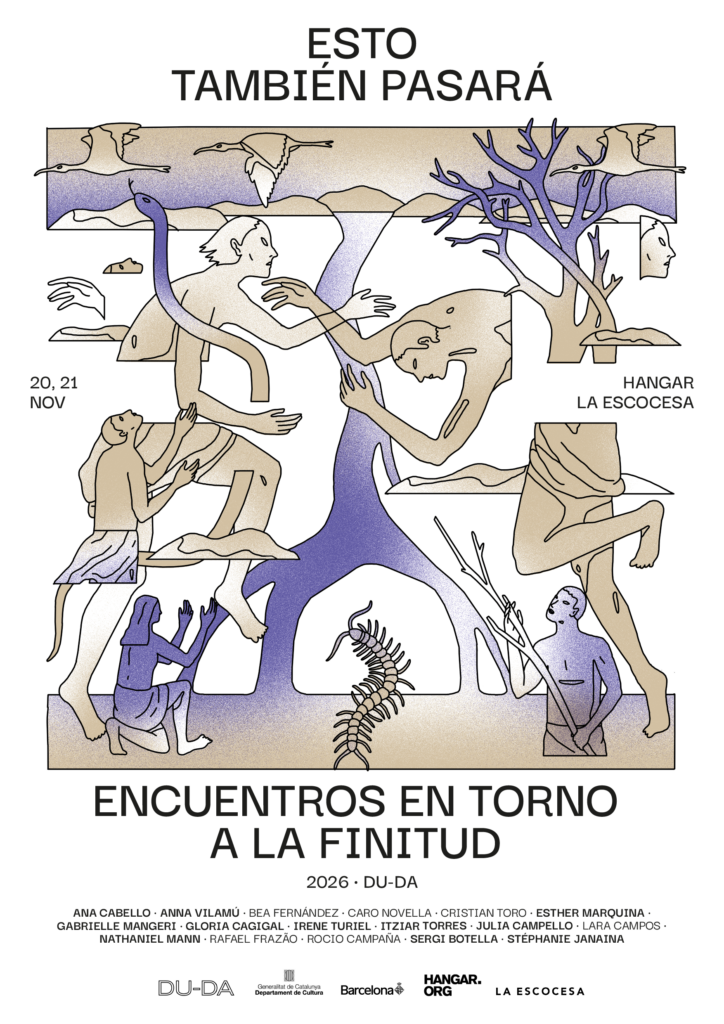
20 NOVEMBER AT LA ESCOCESA
17:30–19:30 Community Practices for End-of-Life Care with Julia Campello, Irene Turiel, Gloria Cagial, Ana Gonzalez Cabello, Itziar G Torres (CASA FARO) and Anna Vilamú.
20:00–21:00 Nathaniel Mann, concert and listening session.
21 NOVEMBER AT HANGAR
18:00–21:00
DU-DA, Petals Falling, Bells Ringing
Stéphanie Janaina, Madre Patria
Sergi Botella, Todos los Muertos
Gaby Mangeri, Death Is Just Another Word for Singing the Blues
21:00–23:00 DJ set by Esther Marquina, Lecciones de geografía, en su mayoría trágicas
Free admission. Please fill in this form to register.
Friday 20/11 · 17,30h to 21h · La Escocesa
17:30–19:30 | Community Practices for End-of-Life Care
This roundtable brings together diverse forms of knowledge and experiences of end-of-life care. Participants include Julia Campello and Irene Turiel, family doctors with specialist training in palliative care; Gloria Cagial, a member of the Buddhist community Casa Virupa; Ana Gonzalez Cabello, a Tibetan interpreter and translator of Buddhist teachings, and co-director of Casa Faro; Itziar G. Torres, who accompanies people through cancer and end-of-life processes and is the founder of Casa Faro; and Anna Vilamú, who explores death and grief through community art.
20:00–21:00 | Concert and Listening Session with Nathaniel Mann
In this session, experimental folk musician Nathaniel Mann brings together original and traditional songs with experimental sound interventions: sonic metaphors for death. Live music is one of the few spaces in which grief can be shared publicly. In the folk music traditions of the United Kingdom in particular, songs have long provided a space for stories of death, loss and remembrance to be passed down through generations and shared among strangers.
BIOGRAPHIES
Ana Gonzalez Cabello is an interpreter of Buddhist teachings. She studied History at Goldsmiths, University of London, and has pursued studies in Tibetan Buddhist philosophy and the Tibetan language in India and France. She teaches meditation and philosophy from an intersectional perspective, with a focus on spiritual anti-extractivism. She is co-director of Casa Faro.
Anna Vilamú is a cultural worker and Biodanza SRT facilitator. She believes in the transformative potential of cultural initiatives rooted in and committed to their contexts. From this perspective, she has developed artistic projects in a range of formats and settings, including exhibitions, publishing and mediation projects in self-managed spaces, associations, educational institutions and art centres. Her practice has generally been collective, drawing methodologically on community-based creation, Biodanza tools and embodied research.
Julia Campello Coll works as a family doctor in Barcelona and has trained in palliative care through the Master’s Degree in Palliative Care at the Autonomous University of Barcelona (UAB). Alongside her clinical practice, she pursues other interests, including illustration and dance, which enrich her sensibility and inform her approach to accompanying others. Her interest in palliative care and in accompanying people through the dying process began several years ago, during her residency in Family and Community Medicine in Granada, through her experience supporting patients in the rural area where she worked. Later, personal experiences of grief deepened her perspective on death and awakened a need to develop new tools for more holistic support throughout advanced illness, dying and bereavement, incorporating psycho-emotional and spiritual dimensions.
Irene Turiel works as a family doctor at the Gornal primary care centre in L’Hospitalet de Llobregat. She is a member of the militant research collective Entrar Afuera (entrarafuera.net), which seeks to think through and invent care practices by reflecting on and acting upon the relationship between public institutions and territories. The collective works with artistic and expressive languages as tools for transforming institutions and care practices. Her interest in palliative care began during her residency in Family and Community Medicine in Gijón and has been shaped by placements in palliative care services, a Master’s Degree in Palliative Care at the University of Valladolid, and an interest in approaches to accompanying the dying process grounded in other epistemologies and traditions.
Itziar G. Torres is a Gestalt-based relational art therapist specialising in illness and end-of-life processes. With more than ten years of experience accompanying creators and artists through creative processes, her work brings together art, psychotherapy and emotional exploration. She also coordinates the team of psychotherapists at Casa Faro and has developed her own practice in poetry and visual arts.
Gloria Cagial is a co-founder of the Buddhist community Casa Virupa. She is part of its educational team, works as a meditation instructor and is responsible for communications at the centre. With a background in philosophy from the University of Barcelona, she has devoted most of her career to teaching and communication. At LAC (Laboratory of Contemplative Arts), a residency centre for artists and thinkers, she also works as a curator of thought and literature.
Nathaniel Mann is an experimental composer, performer and sound designer. His wide-ranging artistic practice connects music and sound art. In 2019, he received the Paul Hamlyn Award, and in 2018 he was awarded an Arts Foundation Fellowship. His work Pigeon Whistles (2013), a flying orchestra of Birmingham Roller pigeons carrying whistles, won the George Butterworth Composition Prize in 2015. He is a member of the experimental folk trios Dead Rat Orchestra and Hack Poets Guild. The latter’s acclaimed debut album, Black Letter Garland (2023), was selected by The Guardian as one of the folk albums of the year.Hack Poets Guild · Dead Rat Orchestra
Saturday 21/11 · 18–23 h · Hangar
The awareness of death trains us in an ethics of attention and care, reminding us that everything is fragile and that all of this, too, shall pass. Over five hours, we want to transform Hangar into a portal, a space of transition and listening. An invitation to celebrate and to grieve together. To approach finitude through artistic practice.
DU-DA will present Petals Falling, Bells Ringing, Sarafina and Mo propose a gathering around death work communities on a peninsula north of Seattle. Next, Stéphanie Janaina will present Madre Patria, a performance that composts a mother’s death in a Mexico that celebrates death while producing it. Then Sergi Botella, with Todos los Muertos, will perform a series of poetic, autobiographical and sonic exercises that turn grief into creative material. Gaby Mangeri will present Death is just another word for singing the blues, a work about the end of a marriage. We will close with Esther Marquina and Lecciones de geografía, en su mayoría trágicas, a sonic journey through absence, anger, nostalgia, bewilderment, memories and loneliness.
Petals Falling, Bells Ringing – DU-DA
Petals Falling, Bells Ringing is an audiovisual piece that emerges from the gathering of the same name. Sarafina and Mo propose a gathering around death work communities on a peninsula north of Seattle. This film is an attempt to share this other world.
DU-DA is a space for research and creation at the intersection of art, health, the body and pedagogies of finitude. Through artistic tools, we create learning contexts and public programmes that bring together expert knowledge, embodied experiences and forms of knowledge that are often excluded from institutional frameworks. We work with an international network of collaborators to address questions that are difficult to approach from within a single discipline.
Madre Patria – Stéphanie Janaina
Madre Patria is a performance about the transformations that follow death and the return of matter to the earth. It emerged from composting my mother’s death on completely scorched ground, and from making visible the passage between public hospitals and healthcare systems that punish vulnerability. It is a journey between pain and relief, dignity and guilt, love and decay.
Along the way, characters appeared who accompanied my mother’s final days, each preparing, in their own way, the farewell ritual. On stage, their voices coexist with mine: recordings made by my mother, archival materials I rediscovered after her death, and my own written and photographic records, kept so as not to forget the cruelty, indifference and contempt, but also so that we could laugh and lighten the process.
Madre Patria is an act of reconciliation with the absurdity of living and dying in Mexico, a country that celebrates death in order to cope with it, but also produces, administers and imposes it.
Stéphanie Janaina works with the body, memory and language as territories where identity is both asserted and blurred. Through the body and performance, she explores ways of inhabiting other languages and making visible what has been silenced by history or violence, proposing artistic practices that question patriarchal and colonial structures. In her work, the body becomes an archive and a bridge: a way of sustaining memory and imagining more sensitive ways of existing together.
Her practice begins with words: she studies them, unearths them or reinvents them, seeking languages that resist oblivion. She explores how these words, sometimes made of gestures or breath, sometimes of inherited memories, can open up other ways of speaking and inhabiting the world. She studies the Mixtec language, specifically the Tnu’u Dau variant, as a choreographic and affective device, a way of keeping the dialogue with her grandmother and a collective history alive.
Todos los Muertos – Sergi Botella – 2026
In Sergi Botella’s practice, death becomes another element through which to shape autobiographical thought. It is an essential part of the cycle of life that, capriciously, appears at key moments. Thinking of those who are no longer here as material for artistic work thus becomes a way of navigating grief and resisting oblivion. Todos los Muertos brings together narrative exercises in which poetry and sound dance, with permission, upon their graves.
At Night
You’re no longer here,
and we are in mourning
for the death of desire.
A small glass box
holding all the light of a day inside,
which howls when you open it.
The night is looking for you.
Sergi Botella (Terrassa, 1976) develops his work through performative presentations, texts and sound: exercises somewhere between fiction and experiential remixing. He draws on his emotional surroundings, as well as on the familiar and everyday, to create new situations from a place of intimacy, rearranging the field of possibilities. His illustrative accounts unfold in an atmosphere charged with self-suggested lies and the most honest stories, each holding the others together. Through artistic practice, these strategies allow him to experiment with forms of fiction that cannot be separated from what is real and true. His is a narrative system in constant development, taking as its starting point the relationships and influences that emerge from the immediate environments in which he moves.
Death is just another word for singing the blues – Gaby Mangeri
Shout!
A marriage dies, becomes a thing of the past. Your bodies will never intertwine again; you will never again be one with yourself and that other person. You struggle to shed the skin of your dead marriage and be reborn. It is an exercise like any other, a conscious force pushing you forward, towards the next dimension of your life.
You must cry. The uncertainty is immense. The sheer magnitude of change. And all of this happens inside your living body.
Move through the pain towards the rays of friendship. How can we heal by caring for others? First, you have to sing the blues, sing them until the sky clears and the dark feelings have disappeared. Then light the fire and feed people from the depths of your new heart. The more you open yourself up, the more wonderful things become.
Gabrielle Mangeri is an artist who resists calling herself an artist. Over the past decade, she has worked as a cultural professional and entrepreneur, combining artistic research with gastronomy, the philosophy of the table, and expressions of eros through hospitality and care — long before she began calling it care.
Her practice focuses on collaboration and relationships with artists from different disciplines, knowledge-sharing, and investigating the true origins of food — starting with the people who work the land. She is particularly interested in the challenges facing food systems today and how they shape our relationship with the wider world. Her experience includes working with collaborative artistic structures such as La Fragua Artist Residency, PLATA and CoMbO in Córdoba, as well as cultural institutions including the Andalusian Centre for Contemporary Art (C3A) and TBA21, among others.
Lecciones de geografía, en su mayoría trágicas – Esther Marquina
Lecciones de geografía, en su mayoría trágicas emerges from this place: a sonic journey through absence, anger, nostalgia, bewilderment, memories and loneliness. But also through the unexpected territory that opens up afterwards: the gradual process of finding another way of being.
Esther Marquina is a sound editor and music programmer. She has worked in cinema for over 20 years, making listening her craft and music a way of moving through the world. Her relationship with sound began in cinema and has expanded into other territories: memory, the body, loss and the things that transform us without asking permission. She selects music from an intimate, narrative perspective, seeking connections between songs, moods and moments in life.